
Built around your programme
Expert-led decisions, connected data and a practical route to the next meaningful experiment.
Fusion’s affinity maturation platform combines natural somatic hypermutation with advanced structural modelling to introduce targeted mutations and evaluate molecular interactions, resulting in antibody variants with enhanced binding affinity and improved stability.
Fusion’s affinity maturation platform combines natural somatic hypermutation with advanced structural modelling to introduce targeted mutations and evaluate molecular interactions, resulting in antibody variants with enhanced binding affinity and improved stability.
We don’t use phage display in our approach. We do something different.
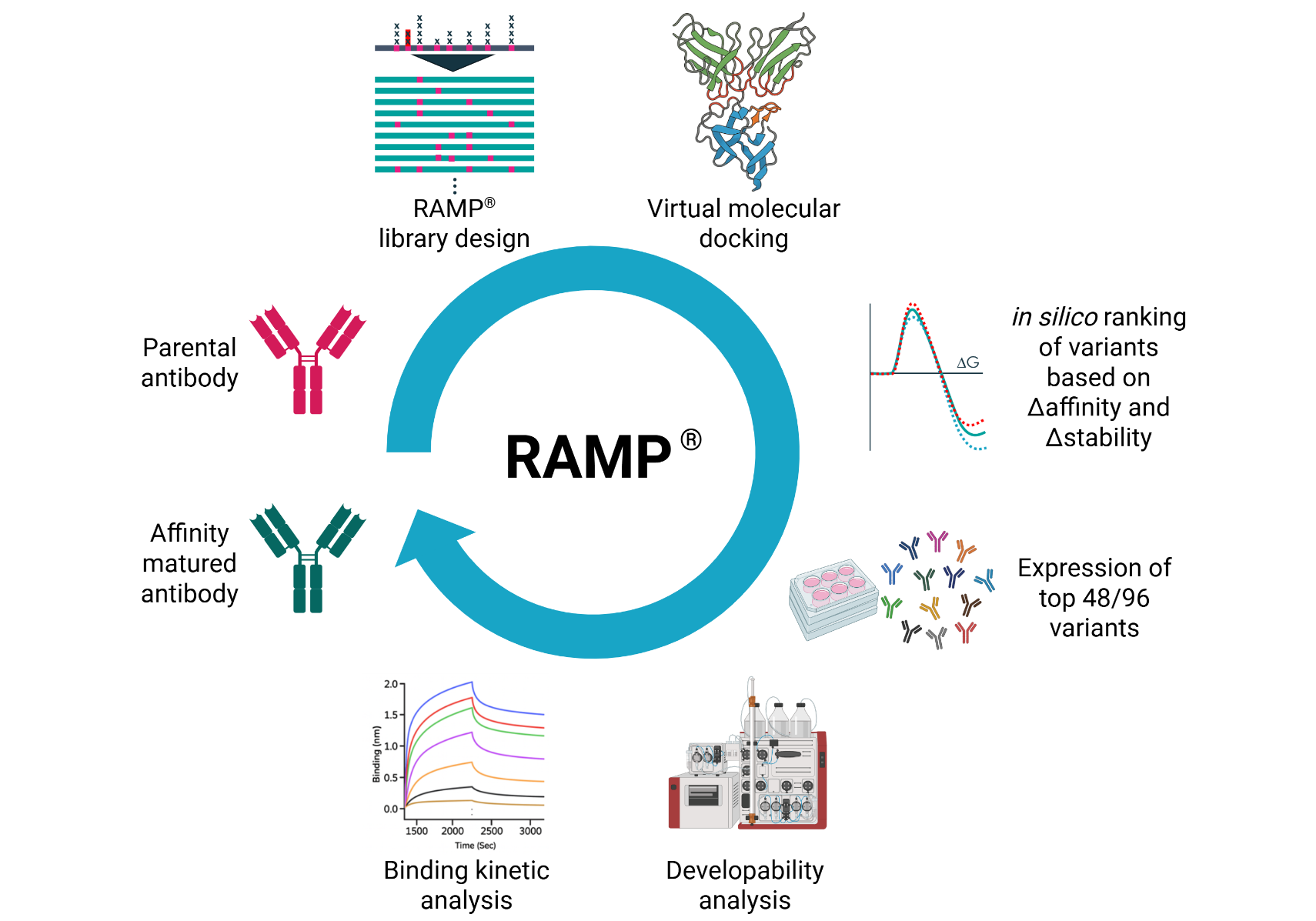
The RAMP® Process
RAMP® employs a proprietary, cutting-edge approach to library design that explores the natural somatic hypermutation landscape of antibody sequences.
This method introduces carefully selected substitutions across both the framework and CDR regions, while applying strict filters to avoid safety and manufacturing liabilities. By mimicking natural mutation patterns, RAMP® can uncover unexpected improvements in antibody performance, including enhanced affinity, stability, and developability.
We analyze the antibody library using advanced in silico modelling and molecular docking to identify variants with predicted enhancements in both binding affinity and structural stability.
This data-driven selection process ensures a careful balance between functional performance and developability - an essential principle at the core of the RAMP® platform.
This rapid selection approach enables us to focus a large virtual library of variants down to a micro-library of approximately 100 sequences for in vitro expression and characterization.
A key advantage of our Affinity Maturation approach is the elimination of the need to express large physical libraries of variants.
With RAMP®, we generate a focused micro-library of carefully selected variants, expressed directly in CHO cells in full-length IgG format. This avoids biases associated with scFv or Fab formats and bypasses stability constraints linked to bacterial expression systems. Each variant is thoroughly characterized in vitro for binding kinetics and biophysical properties.
A high proportion of the expressed monoclonal antibodies demonstrate enhanced affinity compared to the parental antibody, providing a rich pool of candidates for lead selection or further rounds of RAMP® optimization.
Applications:
What Set Us Apart from Other Affinity Maturation Methods?
For more information about affinity maturation
Expert-led decisions, connected data and a practical route to the next meaningful experiment.
Start with the biology, share the context and move forward with confidence.
Yes. Our teams are designed to share context across discovery, engineering and supply.
Share the useful starting details and your enquiry will be sent securely to Fusion’s scientific team.